





























Warning: The following article includes spoilers of “Knives Out” plots.
In the era of political division and cultural debate, few films dare to hint at controversial beliefs while also entertaining audiences. “Knives Out” is one of the few.
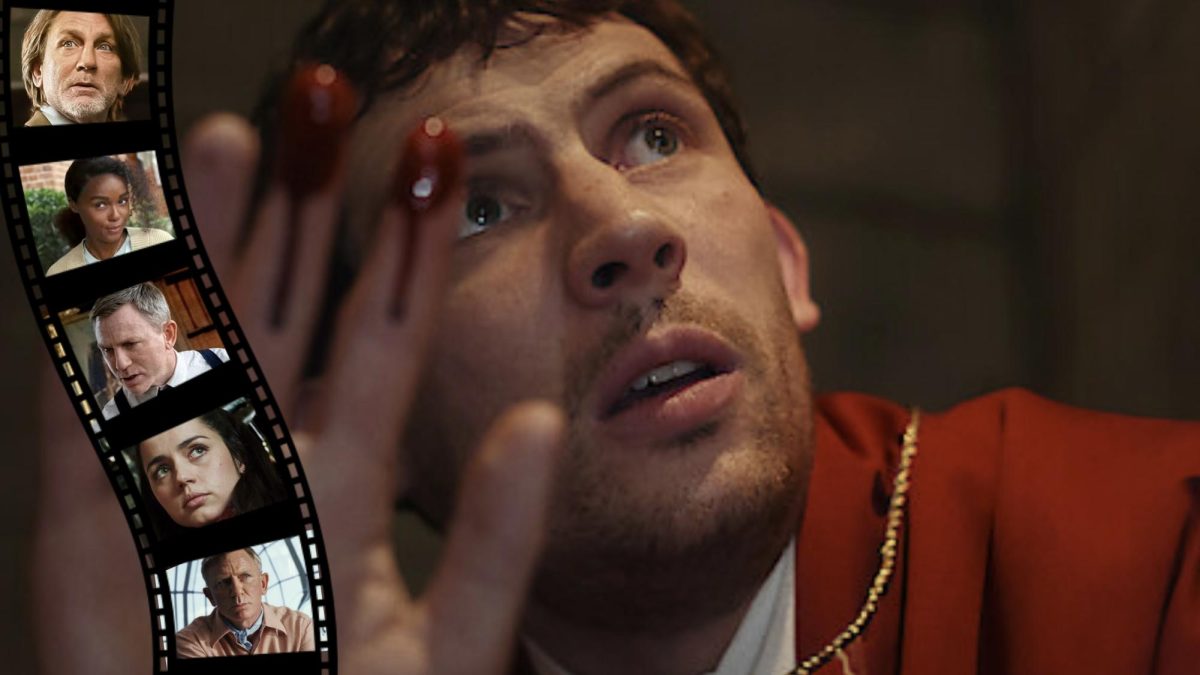
The “Knives Out” franchise is a murder mystery series produced by Rian Johnson, which features Daniel Craig as the brilliant detective Benoit Blanc, who solves an entirely new case in each film. The series is known for its dark comedy, plot twists and exploration of societal issues such as immigration, entitlement and in the latest release, “Wake Up Dead Man,” religion.
“Wake Up Dead Man” is set in a Catholic church, providing insight to the depths of Catholicism. Christianity is represented and put out throughout the media in ways that some find misleading which can leave viewers with a bad taste in their mouth. The notion of Christianity being a purity-based religion — where anything short of perfection leads to damnation — is challenged by newly appointed Catholic priest Jud Duplenticy, played by Josh O’Connor, an ex-boxer whose persisting potty mouth represents opposite characteristics.
But this is not the first time Johnson has explored nuanced subjects in his films. The first “Knives Out” film involves a wealthy author Harlan Thrombey who is found dead. Blanc is hired to investigate the death involving the peculiarly corrupt family. The family’s entitlement and privilege exposes how immense wealth distorts morality by touching on the subject of immigration as well. Home nurse Marta Cabrera is uncomfortably questioned by the entitled Thrombey family, who weaponizes Cabrera’s mother’s undocumented status against her immense kindness and dedication to them.
“Glass Onion,” the sequel, shifts from the first film’s immigration themes to a comedic approach of billionaires and shallow friends. Ironically, Blanc receives his first invite to an annual murder mystery party held on a discrete island. The party soon turns deadly real, prompting Blanc to uncover the friends who betray each other for fame, wealth and power.
Typically, by the third film of a series, viewers are skeptical that new additions could live up to the standard in place. Expectations are low, and no one is surprised when the film turns out to be nothing exciting. However, this film was even more philosophical than previous installments.
“Something about the third one just hit so differently than the previous two,” said Summit junior Lilly Young.
Religion is a much more complex topic than what was discussed in Johnson’s other films. Father Jud drives the narrative, starting with a letter he was instructed to write in order to explain his side of the story.
Father Jud starts the letter from before his priesthood, when he was a boxer who hatefully killed a man. He is seen multiple times objecting to wrongful systems that have been implemented in churches he visits. This results in his bishop-issued-placement to Our Lady of Perpetual Fortitude, a struggling church in New York with an ideologically extreme priest who is losing sight of Biblical values.
Summit sophomore Kirra Risdon added on to this idea by saying, “[The film] was about how churches can blindside you.”
Father Jud is first introduced to Monsignor Wicks, the arrogant and self-serving priest portrayed by Josh Brolin, when Wicks casts his shadow over a remnant of a crucifix. In Wicks’ twisted mind, he is the only force keeping his church alive. But Wicks’ sermons are filled with hate against newcomers which leaves a select few whom he calls his “flock” to stand by his side, utilizing shame and guilt to keep them under his control. The “flock,” consisting of a lawyer, a former cellist, a local physician and others, mirror Wicks’ scathing attitude.
“Father Jud wasn’t just [blindly] following the church,” said Summit sophomore Isabel Maclowry. “Even though Father Jud was supposed to be listening to [Wicks] he was like, ‘this isn’t Christian, you’re not doing things right.’”
When Wicks is stabbed on Good Friday, Father Jud is immediately accused of the murder. Blanc takes Father Jud alongside as an unofficial co-detective. Amidst the chaos of the investigation and proving his innocence, Father Jud begins to stray from his responsibility as a priest. The urge to solve the mystery caused Father Jud to abandon his morality and sink into anger just like Wicks.
While the movie is framed around investigating the murder of Wicks, it deeply explores and encapsulates the deceit and denial that resides in the church. But it also illustrates the delight and fulfillment of a walk through faith and the captivating peace of Christ.
Interestingly, Johnson no longer identifies himself as religious, but he wanted to put all of the things he wishes to see more of from Christians into a leading character.
“It’s a disservice to portray a Christian if he’s not recognizable and human. When I was a Christian, there was doubt, sinfulness and all of those parts of being a real human being,” Johnson explained in an interview.
When Father Jud asked Blanc why he became a priest, Blanc explained, “You felt guilty for taking a life and the church offered you a place to hide and a clear method to give you a sense of absolution.”
Father Jud replied by saying “The guy I killed in the ring, I hated him. I kept going until I felt him break. There’s no hiding from that. God didn’t hide me or fix me. He loves me when I’m guilty. That’s what I should be doing for these people.”
O’Connor doesn’t identify himself as religious either. However, he precisely depicted a character full of passion and unconditional love, which deeply resonates with the characteristics that Christians should possess in their daily life.
“I feel like some people say, ‘I’m Christian,’ but they don’t act that way,” Maclowry continued. “Father Jud is a well-written character. He knew he had flaws and worked around that.”
The film was not made as an attack of Catholicism, but a critique on the corruption, amorality and abuse of religious power within the church.
Johnson’s unmatched ability to balance mystery and meaning is the reason viewers come back to watch each new film. Johnson does not force his agenda or ideas down viewers’ throats, but provokes them to see into the rawness of real-world struggles.