



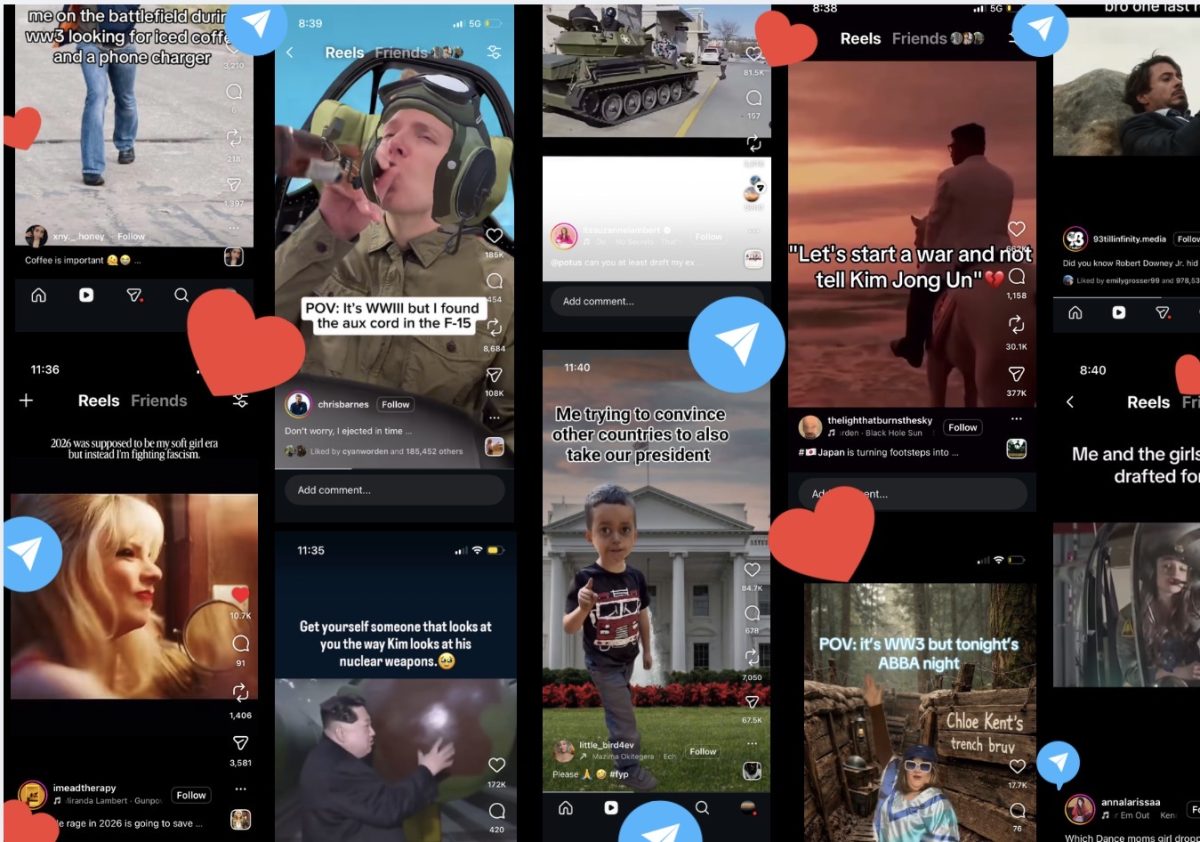








Since the United States’ and Israel’s attack on Iran in late February, I’ve noticed a new variation of the usual “brainrot” videos that inhabit my Instagram. These new videos have footage of things like missiles crashing in fiery eruptions and Instagram filters that place the user as the pilot of a fighter jet, with some incongruously upbeat song playing in the background. Each clip is overlaid with captions like, “when you lowkey fail all ur exams but it’s all good cause ww3 starting in the next episode,” or “POV: It’s WWlll but I found the aux cord in the F-15.” The most recent adaptation I’ve seen is an AI generated video of Kim Jong Un crying while riding into the sunset on a white stallion, the caption saying “Let’s all start a war and not tell Kim Jong Un 💔.”
Within days of the initial strikes on Tehran, Iran’s capital, on Feb. 28, these videos had already begun flooding my feed, most of which appeared before major news outlets started to post updates. While this rapid circulation of wartime imagery, and dark humor, is not new to digital platforms, it’s the humorous, and even taboo tone surrounding the posts that’s shifted in recent years. Since the turn of the century, social media has become a powerful tool to document and publicize global conflict. Most notably, the Arab Spring was an anti-government uprising across the Middle East and North Africa in late 2010 that was organized through X and Facebook, resulting in the overthrowing of multiple long-standing leaders. What’s different now is the way that the content is received, social media has begun to shift away from “call to action” types of content, and more towards something to be interpreted or reframed through the diffusion of the conflict.
The modern digital landscape allows for armed conflict to not only dominate physically on the ground, but to also unleash a sort of “media bomb” onto news channels and social media platforms. The New Yorker describes this integration of trending geopolitical conflict with daily content, by saying that “this is war as professionalized content.” As a result, people carry out their daily activities—pilates, matcha, vlogging, all accompanied by air-strikes and declarations of annihilation, with little-to-no apprehension.
Though impetuous, this familiarity and desensitization to conflict is not baseless. The Independent describes how “Gen Z has inherited a hellscape of global turmoil.” People aged 13-28 have weathered a global pandemic, increasing climate anxiety, a rise in autocracies and right wing fascist movements and near constant violence. Yet this generation has opted to use humor, though inappropriately unserious at times, in place of hatred and resentment they otherwise might direct towards older generations who shrugged off these crises.
For instance, the recent growth in the conflict involving Iran, we’re now in month four, follows years of unrest largely tied to nuclear developments and prolonged instability. An issue that was formerly resolved when Obama made an agreement with Iran in 2015 to limit their Nuclear Program, something Trump withdrew from during his first term, and ironically has since been attempting to recreate.
These big, unmanageable conflicts get condensed and strained into a more controllable and consumable thing. It’s no longer a daunting topic, but instead has been transformed into a laughable one.
“The political world is all so big, and on a larger scale, so out of our [generations] control,” said Summit senior Violet Rodhouse. “Joking about it can be a way to make it manageable.”
When conflict feels both rampant and inevitable, viewing it through humor creates a sense of predictability and control, without denying the gravity of the situation.
Within this context, there is a fine line between ironic posts to help cope with nuclear violence and blatant dismissiveness. Aven Harris, a Summit freshman described how she gets frustrated when she sees aimless posts casting belligerent quips at violence.
“Humor is a powerful way to make things seem less of a ‘big deal,’” Harris said. “I think that people need to understand the seriousness of the issue.”
When older generations (looking at you Millenials, Gen Xers and Boomers) come across posts speaking about serious issues in a humorous light, it’s easy for them to begin doubting Gen Zers’ levels of intellect and professionalism. Most Gen Zers have heard “It’s the damn phones,” from the mouth of a parent or grandparent. Yet this older generation repeatedly fails to recognize this darker sense of humor as a coping strategy. Our, often satirical and callous responses are shaped and circulated within the same digital environment they helped to create. While undoubtedly levels of intellect and professionalism have shifted in younger generations as a result of the digital age , after handing both the global volatility, environmental collapse and the digital coping strategies down to Gen Z, can older adults really deny their part in creating the conditions that allowed for these shifts?
The Independent describes another side of social media older generations are often oblivious to: “more than a third of Gen Zers have turned to activism, aided by their online literacy.” Digital platforms have allowed activists to bypass state censorship, spread real footage of conflict and engage people who otherwise would be insulated from such violence.
The platforms being criticized for trivializing conflict are the same ones actively shaping how younger generations understand and respond to it. The same algorithms circulating petitions and firsthand accounts, also collapse that violence into something consumable. This has fostered a generation equally adept at navigating gravity and absurdity at once.