





























Dear Women,
Have you ever grabbed a bottle of bright red nail polish off the shelf in your local grocery store, and, almost instantaneously, had the echoing agony of innumerable female souls come crashing down upon you?
It can also happen while you’re window shopping at the luxury mall outside your town. Your gaze drifts oh-so-slightly over to a display case in the fancy perfume store, towering with sparkling crystal bottles filled with soft-scented fragrance. But in one slow blink, a different scene appears. Suddenly, in each one of those name-brand bottles, you see not florid liquid, but shining tears, those of a thousand tired, frustrated, broken down and beaten up women.
These women are haunted by the very bottles they are caught in. Bottles advertising immaculate women, their skin glowing and their hair billowing. Slender women with dazzling eyes and polished red nails.
It is these images that flicker before you as the wails come crashing down, and it is these images that reflect an obvious truth. Everywhere we turn, women are expected to be flawlessly perfect by a society that is never satisfied.
The first time you look at Summit senior Gwen Ploski’s art you will be reminded of these moments.
Because, depicted in the silvery lilacs and soft tulip pinks that saturate her canvases, is her interpretation of a very resonant female experience: navigating the labyrinth of standards that the 21st century imposes upon women.
Each new lotion and potion, Botox treatment and tummy tuck surgery, “girl dinner” and 20-minute ab workout puts a new weight on the female consciousness. Every time we open Instagram, we’re shown that we’re not pretty enough. Every time we walk into a gym because someone said we aren’t skinny enough, we walk out of the gym and a different someone says we have “boulder shoulders”. Every single one of our actions, words, thoughts, and emotions are scrutinized for impurities, and every single day we get told we’re too dramatic but not exciting enough, too thoughtful but not smart enough, too empathetic but not caring enough.
It’s never enough.
“[As a woman,] your whole life is based around this idea of perfectionism and it ends up destroying you,” remarks Ploski. Her art explores this very experience.
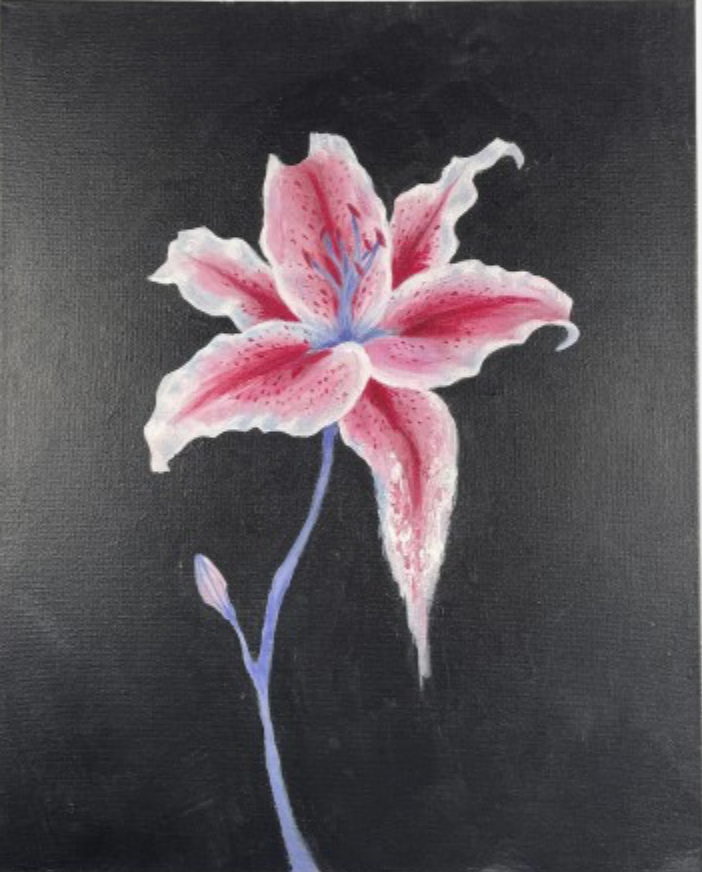
In her first piece, “Almost There,” Ploski illustrates how expectations of perfectionism stretch women petal-thin. On its indigo canvas, her elegant lily melts, its colors streaking through a blue abyss. We are born to bloom, but as we unfurl we are smeared by the pressures of what society believes a woman should be. We are taught to reach for something we can never attain, a flawless form of perfection.
But in her second piece, Ploski reminds us that there is not just one version of perfection. Her collage, titled “More Sprinkles for My Mudpie,” is a portrayal of a different kind of perfection, a slightly messy, wildly carefree, and simply true kind of perfection. This perfection is the kind we knew as children; when we took blooming weeds and made them into vibrant bouquets, wore our homemade Halloween costumes as confident as little queens, and knelt to stare at the sparkle of spilled buttons.
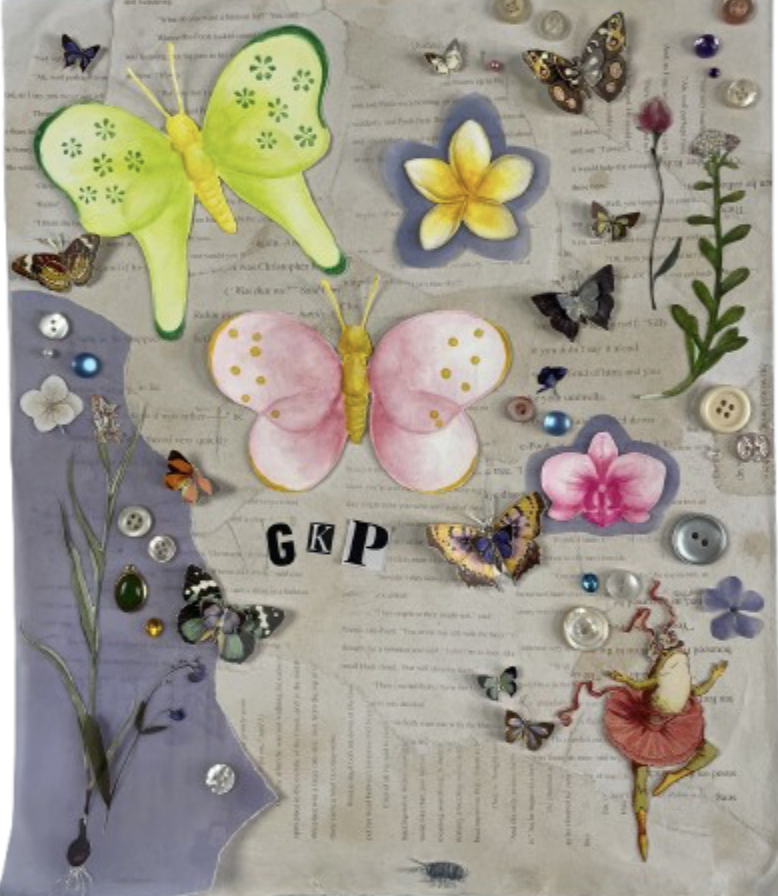
As women, this wild, messy perfection should still be our only standard of the ideal. Society holds us to the standard of flawless perfection, but Ploski’s art reminds us of how we viewed the world as children, knowing that real beauty is never immaculate and can take on all forms.
As we grow, we must remember this. Perfection is the rivulets of mascara-black tears carved on a weeping face. Perfection is frizzy hair, too wild to be confined by overpriced oils. Perfection is pulling a tampon out in class, and not worrying about stuffing it up a sleeve. Perfection is simply women being their truest selves.
Which brings us to Ploski’s final piece. Titled “I Carry Her With Me,” it depicts a thin hand, its bony fingers reaching skyward. Entwined along its length are a slender strand of pearls, serving as a tribute to this hand in its youth, when it knew no other benchmark for beauty.
“The pearls are meant to represent a younger sense of femininity,” describes Ploski. “When we were younger and untainted by societal expectations.”
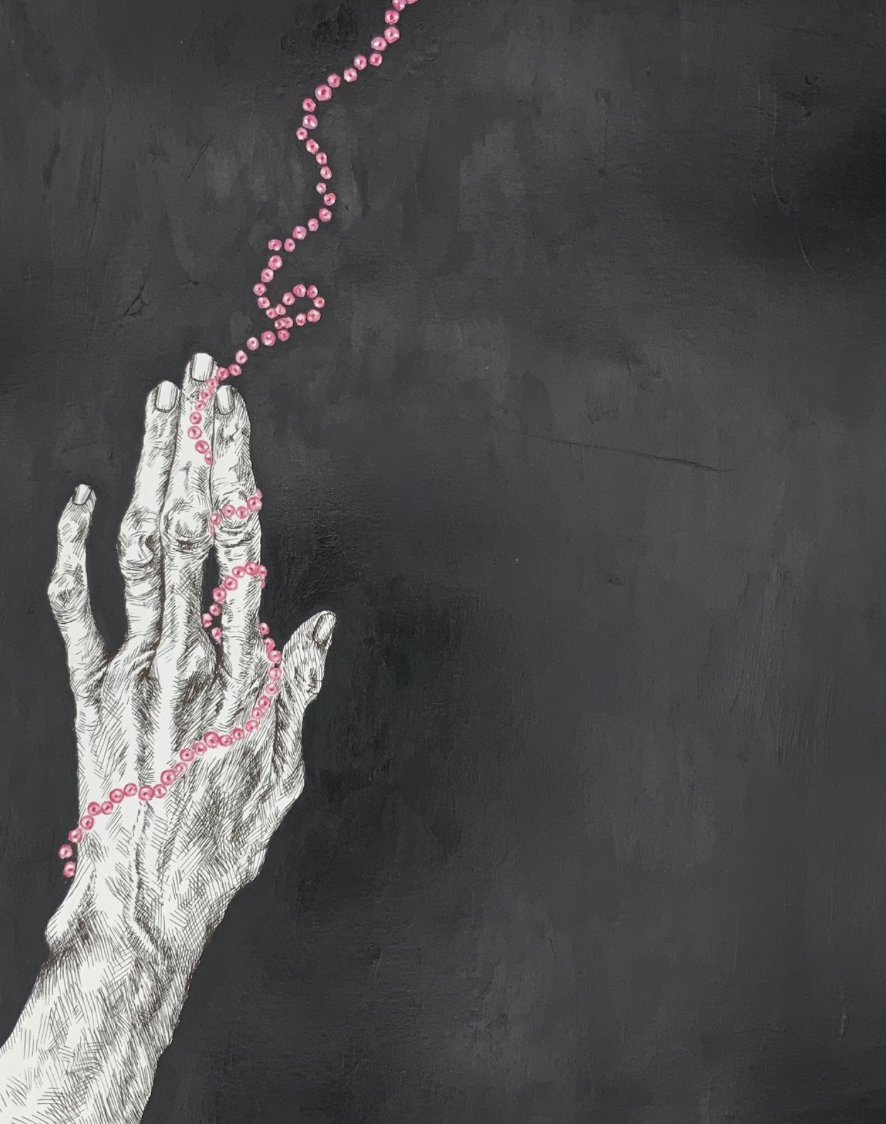
Now, however, it is aged, crimped by wrinkles and darkened by sun spots. If our prejudiced society saw it, anti-aging creams would be hurled forth in rapid-fire, howls of reverse! reverse! reverse! echoing out of misogynistic mouths.
This hand has too many times reflected the face of a tired, frustrated, broken down and beaten up woman in its ten circles of candy red gloss. It has tried, over and over again, to grasp the unrealistic expectations that society dangles above women.
But now, after spending a lifetime attached to the body of a woman who believes she was never enough, Ploski’s painted hand is high above it all. Its wisdom has come from these experiences, and its knowledge is mapped by its wrinkles. It has attained a perfection far beyond that of full lips from Botox or a skinny torso from meager “girl dinners.”
This hand, along with Ploski, reminds every woman that “carrying our childhood sense of femininity with us as we age, and teaching ourselves lessons based on that” is the best way to stand proud of our own perfection, regardless of what our world tells us to be true.