






















Many Summit students know the feeling. When you drop time in a race, score a game-winning goal, tackle an opponent, dribble the ball past your defender or look up in the stands and see your family cheering you on. However, there’s a subset of these students who can only dream of getting these moments back; injuries among student athletes at Summit are frequent and often overlooked.
At a school where football pep rallies are idolized and time-consuming practice schedules are expected of students, there’s nothing more alienating to an athlete than losing the ability to participate in their sport.
“I’ve been playing sports for so long that I never thought I would get a big injury my senior year, which [has been] heartbreaking,” explained senior Esi Voelz.
Voelz was playing in a varsity girls basketball game against Mountain View High School on Jan. 27 when she collided with an opponent and tore her Anterior Cruciate Ligament (ACL), majorly injuring her knee.
Voelz has been a part of sports nearly her whole life. From dance and soccer to basketball and track, athletics have been a major outlet for her. She was looking forward to playing her final season of basketball this year, as well as running track in the spring, but this injury has taken these opportunities away from her.
According to Orthopedic Centers of Colorado more than 5.2 million high school athletes in the United States suffer from injuries each year, with the most common being ACL and meniscus tears, concussions, shoulder dislocations and ankle stress fractures.
For many high schoolers, sports offer opportunities. They’re how students make friends, develop a good work ethic, challenge themselves and gain an overall sense of identity. The National Library of Medicine explains that by being involved in sports, high schoolers lower their chances of developing depression, anxiety and suicidal thoughts. It’s also explained that many high schoolers involved in sports gain leadership skills, emotional intelligence, time management and goal-oriented skills.
For senior Caroline Dersch, going into freshman year at Summit, the girls’ volleyball team was where she was able to feel at home in a new environment.
“[Starting high school] as a part of a team, you have these automatic friends that you’ve been working out with the whole summer, and getting to know,” explained Dersch.
Dersch first started playing volleyball in fifth grade and went on to play club volleyball throughout middle school. By the time she reached high school, she had recovered from a concussion she got in eighth grade, and after lots of physical therapy, she was on track to continue her volleyball career at Summit. Unfortunately, in her freshman year, she got two more concussions, and her symptoms grew worse with each injury, ultimately forcing her to stop playing.
“It was horrible,” said Dersch. “It was so hard on me. I felt like volleyball was such a big part of me, and that’s where I felt the happiest.”
For so many athletes, sports are an identity reassurer. Having a community to rely on and a built-in support system is so beneficial for high schoolers. For injured athletes, it can be difficult to still feel a part of this community, especially when you are no longer able to participate fully in practices and games.
For Dersch, because of her concussions, she wasn’t even allowed to observe practice because she was at risk of getting hit with a ball again, which added another layer of disconnect between her and her team.
“I think a lot of my friends didn’t really understand what I was going through, and it’s hard to just be stuck at home, isolated from everyone,” said Dersch.
Currently, Voelz is experiencing a similar feeling. Although she is able to attend practice and observe, it just isn’t the same as before her injury.
“It’s really hard to feel a part of this sport community when you’re hurt besides going out there and helping. It just doesn’t feel the same as doing the sport,” explained Voelz. “I don’t know how else to be a part of the team now that I can’t even play.”
And this is a harsh reality that injured athletes have to face. Being unable to participate in sports can be extremely isolating. Many athletes are also forced to miss out due to surgery and physical therapy recovery.
“The month that I was required to stay home because I couldn’t walk, everything was awful,” said senior Tanner O’Bryan. “I wanted to be with my teammates so, so badly.”
O’Bryan first found football in third grade. From that moment forward, the sport became a constant in his life. By his junior year of high school, O’Bryan had made his way to the starting line-up of Summit’s football team and was even on track to be recruited to play in college.
However, in January of his junior year, O’Bryan was playing in a game in Seattle when a teammate accidentally dove into his knees, causing his ACL and meniscus to tear immediately. Still, in the wake of this challenge, O’Bryan was determined to remain as close to football as possible.
“I had my surgery at 10 a.m. on a Thursday, [and] at 6 a.m [on Friday] I was at Summit lifting weights with my teammates,” said O’Bryan. “I just did not want things to change.”
This change can be one of the biggest battles for injured athletes. Going from intense practices and schedules catered around students’ next games, to spending weeks at home recovering, with the only scheduled activity being physical therapy. Many athletes also begin to struggle with balancing recovery with schoolwork.
“I can pull up my attendance for the month of February. I don’t think I went to school once,” explained O’Bryan.
A report by Athlecare explains that 96% of injured students experience delayed assignments, 88% report missing tests and 86% miss classes. For high school students, this can create major gaps in their transcripts and greatly affect their education.
For Dersch, school became a new type of challenge, as she had to retrain her brain to function the way it did before her concussions.
“I learned I needed a lot more time to actually read and process what was happening,” said Dersch. “I eventually ended up getting a 504 plan just because I needed more time on tests because I would read [a question] but it wouldn’t process.”
Not only do athletes have to miss so much school to recover, but once they return, they also have a difficult time integrating back into school. Especially at Summit, injured students found some teachers to be more accommodating than others, and even found the school itself posed a challenge.
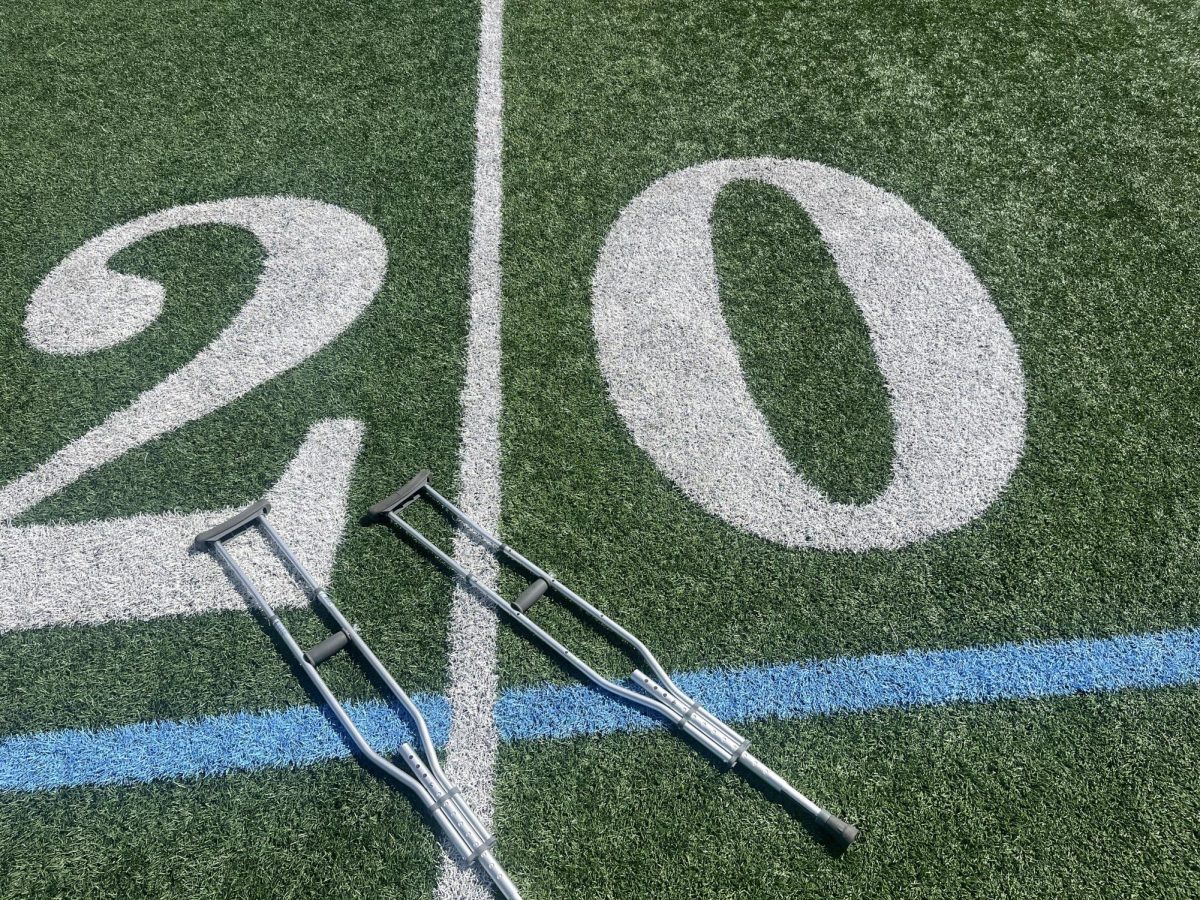
“School on crutches makes everything three times harder,” said O’Bryan. “There’s a lot of things here that aren’t designed for people with crutches or disabilities, and that only became apparent to me after [getting injured].”
So, in the wake of all these challenges, how do injured student athletes keep persevering?
For O’Bryan, staying close to the football team was a non-negotiable, and ended up helping him remain integrated in the community.
“Coach Hyatt did a great job of keeping me involved, and he really emphasized how important it was to stay around the team,” said O’Bryan.
At every chance he got O’Bryan, was lifting weights with the team, doing physical therapy exercises on the sidelines and working to get back on the field. O’Bryan even chose to have a special type of ACL surgery, which allowed him to return to football two and a half months early to play his senior year.
“When I first tore it, [my doctor’s] first question was, how important is football to you? Because he did not want me to play,” explained O’Bryan. “I told him [football] was the most important thing in my life, and [I was] gonna do whatever I could do to play.”
For many Summit athletes, sports are such an important part of their lives, and for athletes who don’t have the option to return to sports, this change can be devastating.
“I do sometimes look back and I was so happy,” said Dersch. “I miss [volleyball] ’cause I think especially at Summit sports are such a big thing, and that’s just been hard.”
Summit fosters an environment that builds state champions and collegiate athletes, so being unable to contribute to Summit’s athletic dominance can be difficult on students.
“I definitely took playing [football] for granted,” said O’Bryan.
And even for athletes who are able to recover, many of their sports careers are over after high school, which can be difficult to digest. Going into college in August, Voelz worries if her injury will be recovered in time.
“I don’t want to go to college and still be in pain,” said Voelz. “I’m not going to be able to do a lot of the first year things that I wanted to do in college, which really sucks.”
For a lot of these students, being injured has taught them not only a lot about themselves, but also about the importance of taking the recovery process seriously.
“Don’t rush the healing process because if you do that, then you’re just more likely to get hurt later on,” said Dersch.
“I think it’s really important to consider the future of your life,” said O’Bryan. “If something doesn’t feel right, take a break or go lighter, really listen to your body, ’cause I think ultimately it knows best.”
So, while many Summit students will go on to continue experiencing the emotions that come with touchdowns, hat-tricks and penalty kicks — there will also be students sitting on the sidelines, struggling to carry school supplies with crutches, and enduring hours of painful physical therapy all for the love of their sport. And in a sports-focused environment like Summit, It’s important to remember who the student is before the athlete — someone worthy of attention, and valued even in the absence of athletic prominence.