























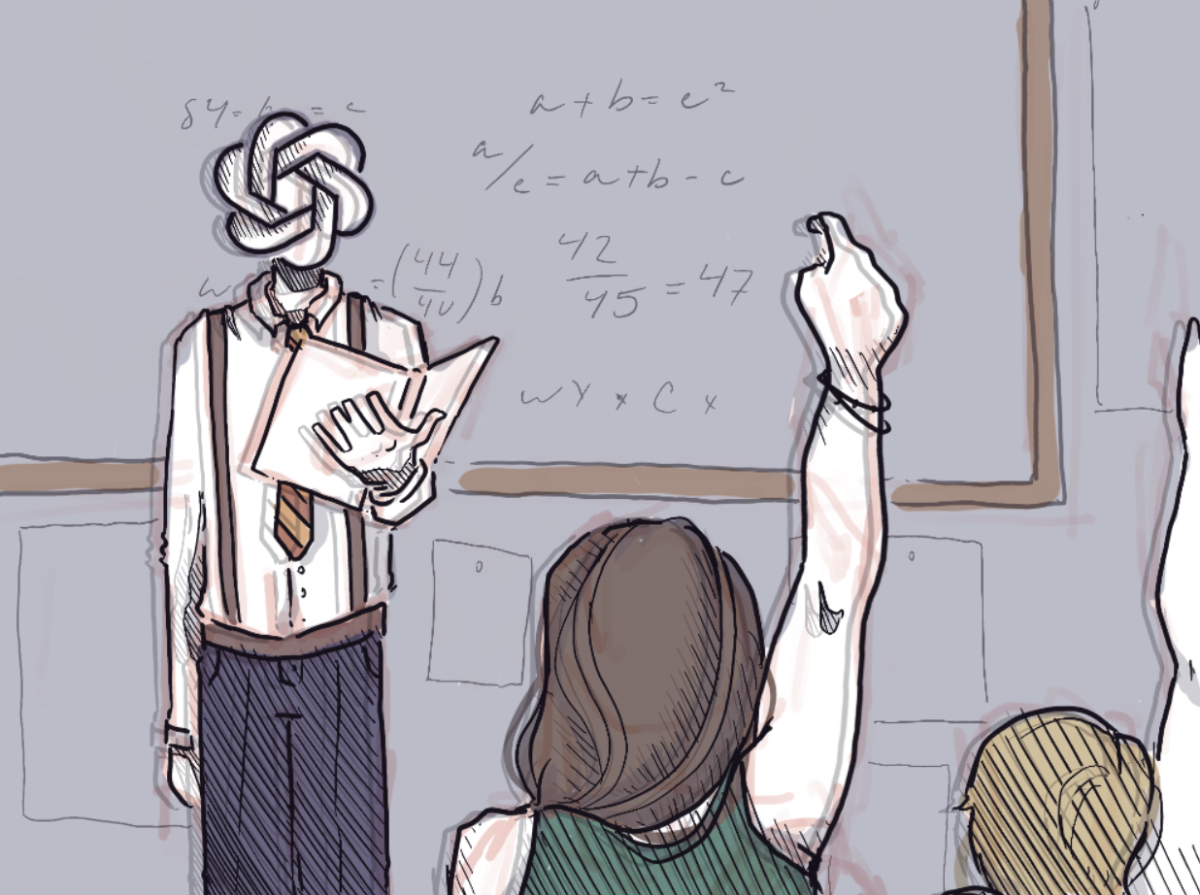
This year, more teachers have been leaning on artificial intelligence (AI) aids in their classrooms, highlighting the technology’s ability to change the face of education with its potential to save teachers time but also erode trust, decrease credibility and strain relationships.
AI has long since made its way into classrooms, being used by students to — yes — cheat, but also to help teach themselves how to connect with content.
Nevertheless, students have become overly reliant on AI and are using it at alarming rates; a College Board study reports that 84% of students surveyed used AI in May, 2025 for research, brainstorming, essay revisions and more. But still, there’s hypocrisy in teachers using AI and critiquing their students who do the same.
“[Teachers] using AI at all in the school normalizes students to use it on assignments,” said Adaline Harrelson, a senior at Summit who has noticed many of her teachers using AI. “I think if we ban AI for students, we should ban it for everyone.”
Relying on AI reduces critical thinking skills and this issue is amplified when students and teachers obtain AI’s biased information. AI is new and exciting, prompting many people to experiment with different platforms before they know what they are doing.
The reality is, AI is inevitable and its impacts are already starting to be seen in student critical thinking and motivation. According to a study by the British Educational Research Association, there may be deep consequences of hybrid human-AI learning. The researchers found that when students use Chat GPT along with their in person instruction, many experience “metacognitive laziness” and an increased reliance on technology, proving students are using AI to sidestep learning and teachers may be doing so as well.
This school year, Bend-La Pine rolled out its new AI policy, a document with broad, unexplicit directions — mostly specified around student use — that left distinguishing AI uses largely up to educators themselves.
Along with these new policies, teachers were required to include an AI statement in their syllabuses specifying what is deemed as “misuse of AI” by students. Descriptions of misuse include “submitting AI-generated work as your original work” and “bypassing a learning opportunity” through AI.
This vague statement applies to teachers as well. Now more than ever, students are looking to their teachers to be transparent and model proper behavior with the technology. With teachers increasingly using AI to grade tests, prepare lessons and spark ideas, many are left wondering where educators should draw the line.
A report by the Center for Democracy and Technology found that 85% of teachers surveyed used AI in their classrooms during the 2024–25 school year. The survey also found that 50% of students polled responded that AI made them feel “less connected” to their teachers.
Summit senior Mataya Zanger reports she has multiple teachers using AI and it is negatively changing her classroom interactions.
“I feel like the [student-teacher] connection comes from what they’re teaching you, and how you receive it. [When teachers use too much AI] it feels like that’s just not there anymore,” said Zanger.
Most students understand how much stress teachers are under and their reasons behind experimenting with new technology in their classrooms.
“I think teachers have it really hard because they don’t really get paid enough to be putting in as much work as they do currently,” said Harrelson.
In addition to drafting lesson plans and activities, teachers must accomplish many administrative tasks including creating rubrics, emailing parents, attending meetings, policing student phone use, managing attendance and tardies and, next year, assigning standards-based grading categories to different standards.
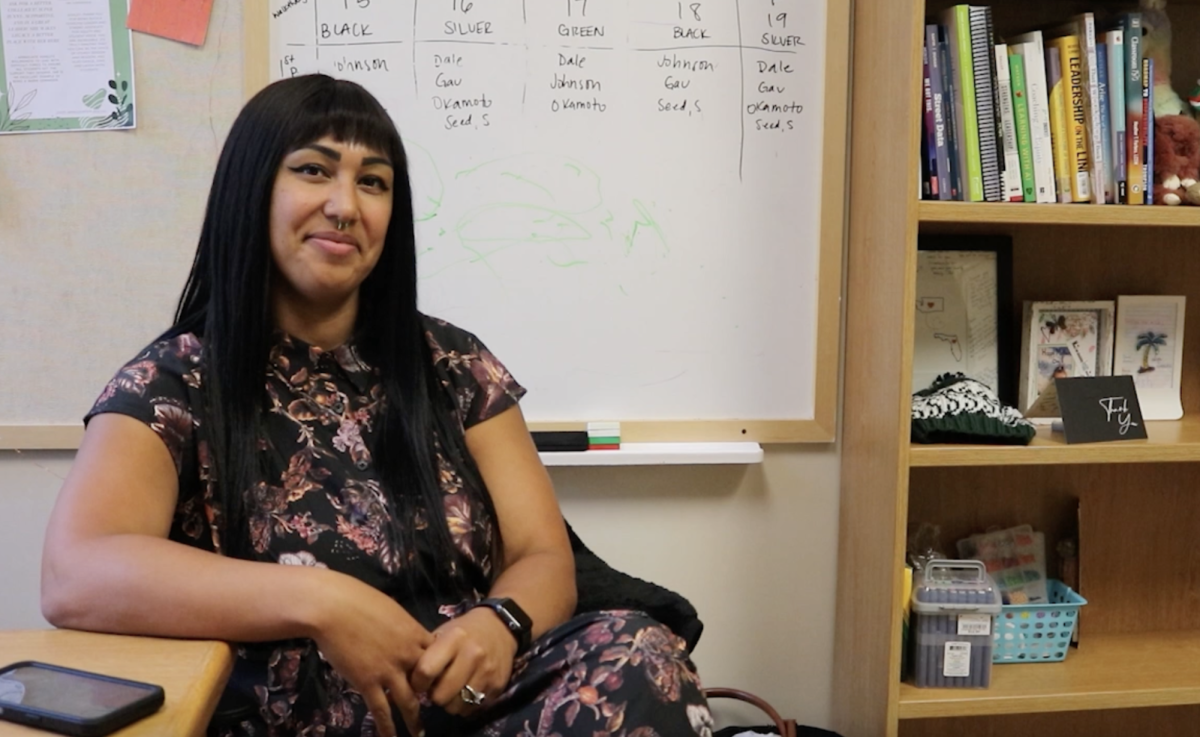
“There’s so many new things coming at me,” said Emily Tompkins, a psychology and history teacher at Summit. “But the number one way that I use ChatGPT in teaching is making a rubric.”
But there is a crucial difference between using AI to save time on formulaic tasks, like creating rubrics, and using it as a crutch.
“Maybe a lesson or two here taken from AI is fine, but if you’re planning your entire course based on things that aren’t your own knowledge then we need to look at building in more time for teachers to gain that knowledge,” said Tompkins.
Some teachers have years of existing knowledge and experience teaching their classes whereas others are working to learn a textbook’s worth of material while simultaneously teaching it.
Summit teacher Holly Graham reports a steep learning curve as she makes the switch from teaching Spanish to teaching American Government and Modern World History, being forced to create a new class structure in the process.
“This year, I’m coming back teaching subjects I haven’t taught since 2006 and I had had all my lesson plans that I had spent so much time developing,” said Graham.
With some educators learning their new subjects alongside their students, students have picked up on their teachers turning to AI to help themselves get up to speed. The problem is, when an instructor becomes overly reliant on AI software to create their lessons, the quality of the information they are teaching may decline. Such a disconnect can often leave students feeling lost and confused.
“It feels like some teachers don’t always know exactly what they’re teaching… I just wish [teachers] understood a little bit more of what they were teaching than just AI,” said Zanger.
Teachers who have expansive knowledge in their subject may find that AI doesn’t always produce what they are looking for, something that teachers may discover too late.
“I’ll come up with a new idea… and I’ll put my idea into AI and then I’ll say, ‘Wow, that’s amazing,’” Graham said. “[But sometimes when] I try it with the students, it falls totally flat.”
And that’s just it: Teachers who use AI for more than just brainstorming are finding that it can backfire. AI isn’t human and its outputs struggle to match the nuance students need to learn. AI is taking teachers’ ideas and putting it in a format that doesn’t mesh with teachers’ personalities, course relevance or students’ perspectives. Additionally, AI is prone to spreading potentially biased, false or misleading information.
“Some of the things we do in class are not as well explained by AI as they are by a teacher,” said Lily Capozzi, a sophomore at Summit.
Capozzi went on to describe an instance where a teacher supplied her with a set of AI generated practice test questions that did not align with the class’s current unit.
When using AI, teachers should check the software’s outputs and draw on prior knowledge, or at least ensure that their outputs are cohesive and coherent. AI best practices don’t change based on the user and students and teachers alike may find themselves using AI as a crutch. Instead when making classroom content, educators should use it for sparking ideas, not solely creating them.
“I don’t think teachers are being lazy,” said Tompkins. “I think it’s an ‘I don’t have time to grade and make it an amazing lesson plan and a rubric and figure out this new grading system and new technology systems in the day that I’m paid for’ issue.”
Tompkins is getting at the root of the argument. Teachers have very little time to complete all their tasks, especially with classes of 35 to 40 students. A part of this controversy is found within the system and not teachers themselves. Educators would benefit from paid time over the summer to prepare for their classes, a solution that would potentially sway less teachers to use AI. Yes, teachers currently have one paid prep week prior to the start of each school year, but what about new-to-the-course teachers? How can they be expected to draft a year’s worth of quality curriculum in just one week?
Teachers not only need more time to prepare to teach their classes, but they also need to receive more training on AI so they can better navigate the new technology.
“At the beginning of the year, somebody showed us Magic School [an AI software that the district subscribes to] but we weren’t trained on how you can really use it for deeper thinking,” said Graham.
With AI developing so fast, teachers, district administrators and students are struggling to stay ahead and understand the software. Teachers and students have both jumped to use the new tech, initially ignoring its many accompanying pitfalls. Someone who doesn’t know how to use a parachute shouldn’t go skydive; perhaps AI should be treated the same. Individuals who are inexperienced with prompting these chatbots should be more critical of what it produces.
There are so many variables surrounding AI and a lack of understanding on how to use them. Moving forward, both students and teachers need more guidance and training on how to approach AI with caution and use it as a tool and not a crutch. Teachers and in person instruction are now more important than ever and educators need to ensure that their course is something that allows students to explore new ideas.
“My job is to get students to think critically about psychology or history or how that affects us in the real world, not the AI world,” said Tompkins.