










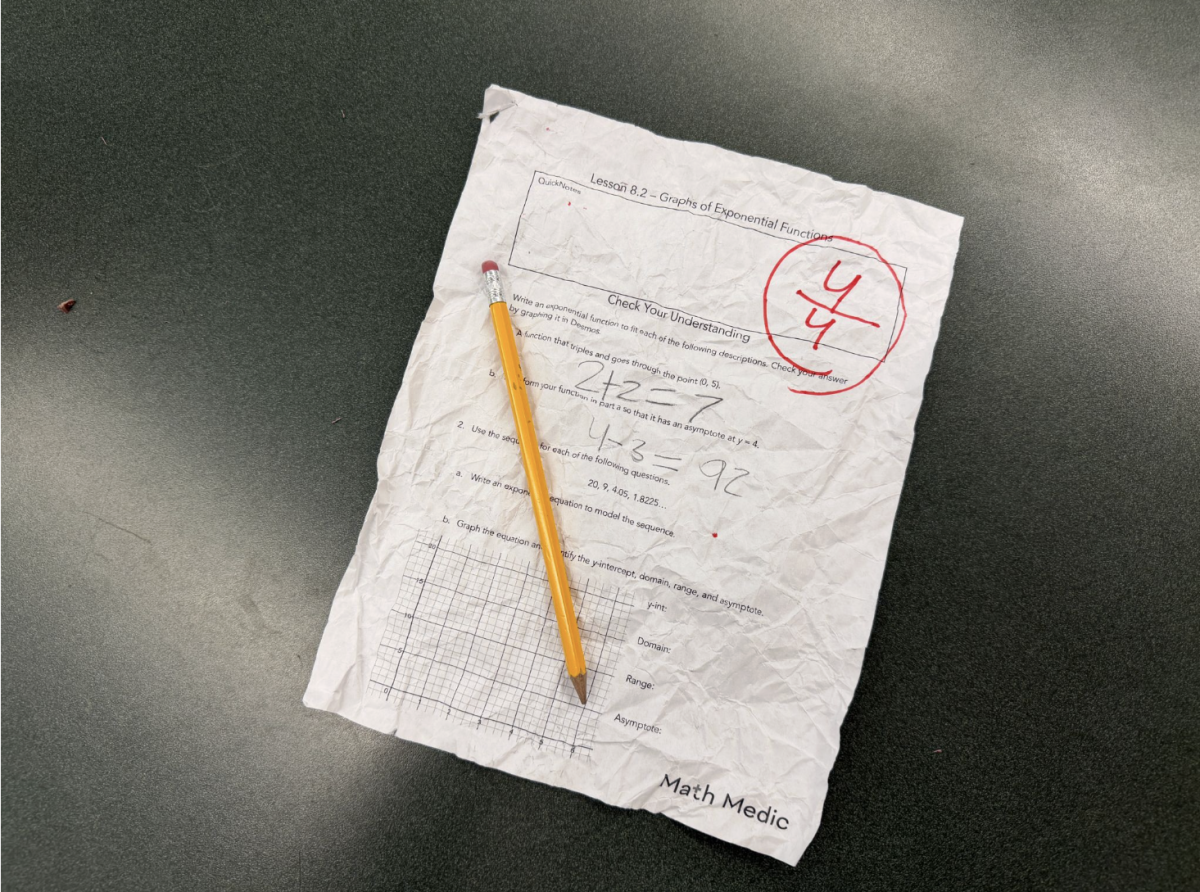





















Sitting in the back of a classroom, students brace themselves as a familiar announcement cuts through the room: “I’m coming around to pass back tests.” For some, it creates anxiety, the fear of earning a bad grade despite hours of studying. For others, their A is already expected.
A student’s academic success, however, is rarely consistent across all subjects. Some struggle to understand equations or memorize historical dates, and others learn the same material effortlessly. This split raises the question: Are academic strengths a result of our cognitive processes, or do they form from experiences that shaped us?
For Summit junior John Freeman, math has always come to him naturally. While many students rely on hours of AP Classroom videos and review, Freeman understands the concepts easily.
“I think I’m a good problem solver, and it just works out in my head,” Freeman said. “It makes a lot more sense than English or language does, and even compared to physics, math just comes naturally.”
That natural talent does not extend equally across all subjects for him. Freeman explained that while math requires little preparation, English-related tasks require significantly more effort.
“For the SAT, I didn’t study math at all,” he said. “But the reading section I found was challenging.”
This phenomenon isn’t unique to Freeman, or math. Summit Senior Kennan Lahey has a similar passion but for art and creative pursuits, rather than more numerically-focused subjects.
“My best subjects are more creatively constructed,” Lahey said. “In math or government, I have a hard time keeping things in my head.”
Researchers suggest that these differences may come from differences in working memory, or the brain’s ability to store and recognize information for short periods of time.
A 2015 study conducted by researchers at Virginia Tech found that working memory and recollection are strongly correlated with higher test scores, particularly in detail-heavy subjects such as math and history.
While history and math require a lot of memorization, math also includes comprehension and problem-solving skills, something that Summit junior Rachel Lynch struggles with.
“My best subjects are definitely history or English,” Lynch said. “In math, I have a hard time figuring out what to use and when.”
One common theme among students is that their strengths in certain areas are often attributed to teachers they’ve had along the way. Freeman recalled a substitute teacher who required students to complete all math problems mentally during tests. While the experience wasn’t positive at the time, it later helped him develop faster problem-solving skills and improve his test-taking abilities.
Lynch and Lahey shared similar experiences, though theirs were driven more by encouragement than pressure. Instead of being forced to excel, they had teachers they wanted to impress, which pushed them to do their best.
Even though there is no definitive answer to what makes someone succeed in a certain subject, passion and genuine interest often play a major role.
Since students don’t all process and apply information in the same way, comparing one’s grade to someone else’s is an action that can be ignorant to the many factors that influence academic performance.
While one student may grasp equations instantly, another may thrive in discussion, writing or creative work. Academic ability isn’t a single standard to meet, but a range of skills shaped by experience, instruction and interest over time.