































It’s 9 a.m., and I’m sitting in Math in Society. As a senior I forecasted for this lower level class, seeking a break in my schedule, which is otherwise full of AP courses, advanced classes, and time-consuming extracurriculars. I fill out the class’s latest worksheet, solving basic algebra and conversion problems on my own, and then going over my answers with the rest of the class. But what strikes me more than the math answers, which are basically spoon-fed to us, is the entirely blank paper of the guy sitting across from me. It seems he spent the class period staring into space and now looks to me for answers, hastily copying off of my paper onto his own before the bell rings.
Unfortunately, this is a pattern I’ve seen all throughout Summit. And in situations like these, I find myself wondering one question; why is it that I’m so much more motivated than the male students around me?
Summit student and senior Anja Prochaska has been in similarly frustrating scenarios.
“I feel like guys don’t really care as much, I get texts all the time just asking for homework answers,” said Prochaska. “It’s not that hard, do it yourself.”
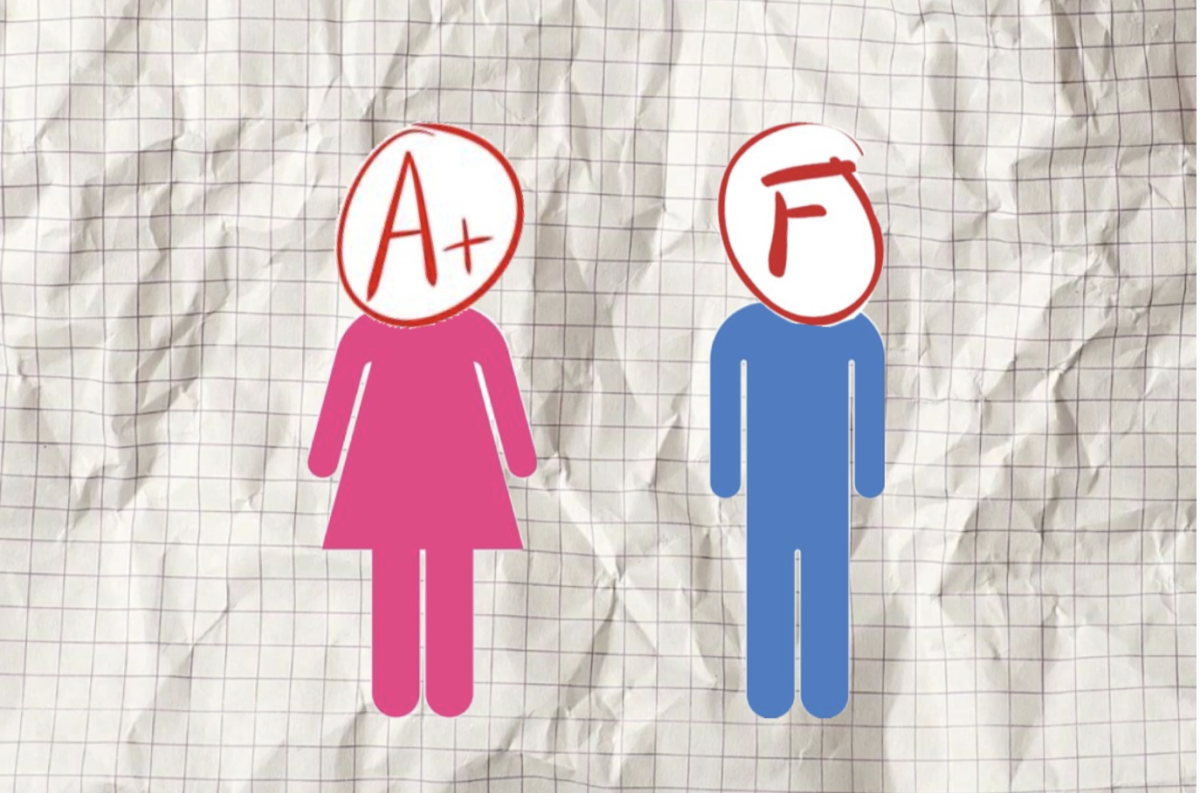
This pattern isn’t just prevalent at Summit. Girls have begun to pull far ahead of boys academically nationwide. Over the past decade, more than 2 million more women than men have graduated from college, and the average high school GPA difference has increased as well. In Washington alone, 51% of girls graduated with a GPA above 3.0 in 2023, while only 36% of boys graduated with a GPA above 3.0. These statistics aren’t just seen at the national level, Summit Math in Society teacher Madison Shore has seen this difference in her own classroom.
“I’m seeing females submit homework more regularly and accurately. And then also in addition to homework, I would say in class participation,” said Shore.
Educators and female students aren’t the only people who are noticing this gap in motivation. As a male student at Summit, senior Galen Steiner has not just witnessed this divide, but has experienced it himself.
“I see way more guys and hear more stories of guys just straight up failing classes, or not doing the work,” said Steiner. “I’m in this group project right now [that’s all guys], I love the group members, but I missed one day and we’re at the same spot we were before I missed.”
This gap in gender academic motivation and achievement has been alarmingly increasing, leading both educators and their pupils to question why this lead has become so significant. Women have greatly pulled ahead of men academically, which contrasts with the fact that from the beginning of the educational system, boys have always been prioritized over girls.
With the first all-girls schools opening in the early 1800s, women were already centuries behind men when they began to receive an education. And even then, men made it extremely difficult for women to be in these male dominated spaces. An example of the extremes taken is explained by Livia Gershon’s article, “The End of Men, in 1870.”
Throughout her article she explains how women were constantly mistreated and marginalized, specifically how universities would make sexist claims to deny women access to higher education. One example is Physiologist Edward H. Clarke, who publicly argued against women’s admittance to Harvard based on the claim that “the energy required to learn subjects like algebra would flow from other bodily systems, harming their ovaries,” claimed Gershon.
Ignorant and discriminatory claims like these were constantly used to leave women out in educational environments, and were perhaps originally put in place to combat the fact that women were capable of higher academic achievement than men. A statement which has been proven today.
When asking Summit staff members and students why they think this gender gap in motivation and educational achievement is so prevalent today, there were two main theories — the first of which is explained by the developmental differences between men and women.
Because girls tend to mature much earlier than boys, by the time they reach high school they are more prepared and motivated for academic environments. In Education Weekly’s article “Why School Isn’t Working for Many Boys and What Could Help,” research shows that boys tend to have a harder time sitting still, are less expected to take on leadership positions and aren’t as motivated to do well academically. It has been proven that boys are much more likely to gravitate towards physical activity at a young age than to traditional academic routine.
“I think that more hands-on learning for [boys] is more powerful for them than sitting at a desk and taking notes. You’re not going to find many [young] boys that are just wanting to get into a classroom,” said Shore.
These innate differences certainly play a role in this shift in academic priority between men and women, however, there are also theories that this academic gender gap has to do with the different societal expectations placed on men and women.
Many Summit students feel there are clearly divided roles that girls and boys have been taught to fit in the classroom. Junior Autumn Junker has noticed a difference in effort because of these roles.
“I feel like society makes it weirder for guys to give a full effort in a class, while for a girl it’s expected for us to give a full effort,” said Junker.
If the predicted quality and completion of work for men and women is held to different standards, then women are more likely to feel the pressure to exceed and meet those expectations in the classroom. So if men experience much lower levels of pressure in academic settings, they may lack the academic urgency that many women have.
“I think in general women have to perform better to get better positions and jobs or to get promoted, because it’s harder for women, and a lot of men in those high positions don’t take them seriously,” said Prochaska.
Prochaska elaborated that she thinks girls take schoolwork more seriously because they feel more pressure about their future, and they want to prove themselves in society. Whereas many guys don’t feel this same pressure, which ultimately leads to their lack of urgency and care.
“[Grades] aren’t as important as extracurriculars to me. I don’t feel super validated by getting a good grade. I don’t think it’s a good measure of my worth,” explained Steiner.
Steiner elaborated that many of his friends prioritize their time outside of school, playing guitar, skiing, rock climbing and try to do the least amount of schoolwork during this time as possible.
“Taking five APs just sounds like a nightmare. I know it’s good for my transcript, but that much work, I just feel like I’d be missing out. I’d be putting so much time into school, I would not be having any fun at all, I’d be miserable,” said Steiner.
And while these findings aren’t definitive for all kinds of learners, it’s clear that everyone’s academic priorities differ. If women continue their dominance in the classroom, and there isn’t an extreme shift in male motivational priority, there will be a ripple effect on what academic society looks like in the future.
With this gap in academic achievement continuing to grow, it’s only a matter of time before we start to see more women in previously male-dominated fields. It’s safe to say there will be more female CEOs, bosses and one day, presidents.